


On this page
- Quick Answer: Can you sue a prison for sexual abuse?
- Quick Facts: Prison sexual abuse claims
- What kinds of sexual abuse occur in prisons and detention centers?
- Which correctional facilities can face sexual abuse claims?
- Can an inmate sue a correctional officer or state prison?
- Can a survivor sue a federal prison or BOP employee?
- Can you sue a private prison company?
- What does the Prison Rape Elimination Act require?
- What legal barriers affect prison sexual abuse lawsuits?
- Can someone sue after being released from prison?
- What evidence supports a prison sexual abuse claim?
- How common is sexual abuse in U.S. prisons?
- What happened in the FCI Dublin sexual abuse cases?
- What compensation can prison sexual abuse survivors seek?
- Talk to a lawyer about prison or jail sexual abuse
- Frequently asked questions about prison sexual abuse lawsuits
In the federal government’s most recent national survey of people in state and federal prisons, 4.1% of adults said they had been sexually victimized while incarcerated. In 2.2% of cases, the person responsible was a staff member, according to the Bureau of Justice Statistics.
Sexual abuse is never part of anyone’s sentence. People abused by a correctional officer, or assaulted by another incarcerated person after staff ignored the warning signs, can bring a civil lawsuit. That holds whether they’re still in custody or have since been released.
How that case works depends on who runs the facility. A claim against a state prison officer, a county jail, a federal Bureau of Prisons employee or a private prison company each follows its own rules. Those rules decide who can be sued, which steps come before filing and how long a survivor has to act. Custody status matters too, because some of the strictest procedural rules only apply to people who are still incarcerated when they file.
Quick Answer: Can you sue a prison for sexual abuse?
Yes, in many cases. The type of lawsuit depends on who operated the facility.
- State prison or local jail: Survivors can sue the officers involved under the federal civil rights law, 42 U.S.C. § 1983. A county or city can also be sued when its own policies or customs led to the abuse. A state itself can’t be sued for money damages under § 1983.
- Federal prison: Abuse by Bureau of Prisons staff usually goes through the Federal Tort Claims Act, which requires an administrative claim with the agency before any lawsuit.
- Private prison: These companies and their employees face state law injury claims, and civil rights claims when they run state or local facilities.
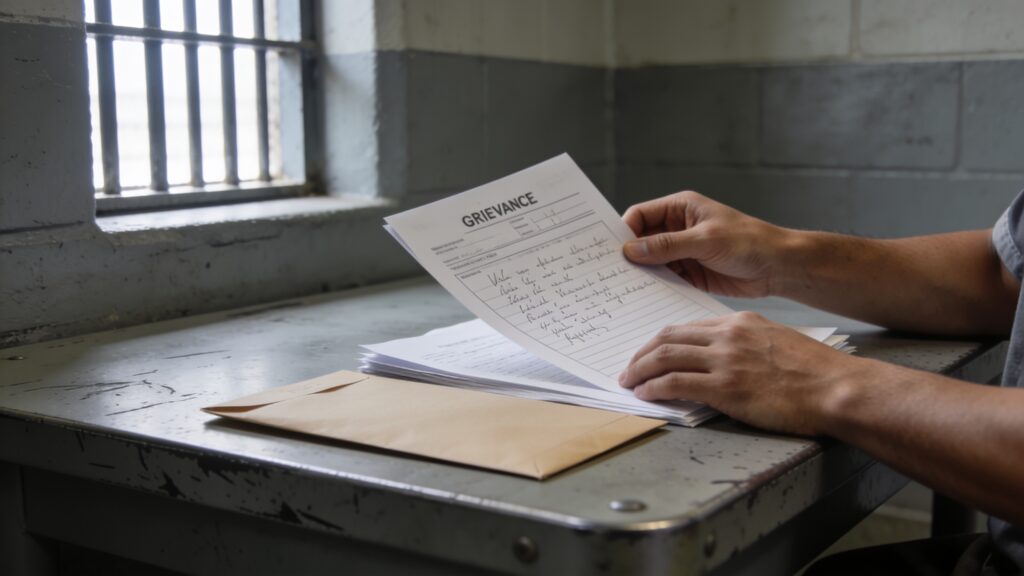
A person who is still incarcerated has to use the facility’s grievance process before filing in federal court.
Quick Facts: Prison sexual abuse claims
- Reported victimization rate: 4.1% of adults in U.S. prisons reported sexual victimization in the prior 12 months in the BJS survey covering 2023 and 2024, released Dec. 9, 2025.
- Who was responsible: 2.3% reported abuse by another incarcerated person and 2.2% by facility staff. Some people reported both, so the categories overlap.
- Federal law on prison rape: The Prison Rape Elimination Act of 2003 (PREA) led to national standards for prevention, reporting, investigations and audits. It doesn’t give survivors a right to sue for damages on its own.
- Grievance requirement: People in custody must exhaust “such administrative remedies as are available” before suing over prison conditions (42 U.S.C. § 1997e(a)).
- Emotional injury rule: Federal law bars prisoner claims for mental or emotional injury without “a prior showing of physical injury or the commission of a sexual act” (42 U.S.C. § 1997e(e)). Congress added the sexual act language in 2013.
- Largest recent federal case: The U.S. agreed to pay nearly $116 million to settle claims from 103 women abused at FCI Dublin, a federal women’s prison in California.
What kinds of sexual abuse occur in prisons and detention centers?
Sexual abuse in custody includes sexual contact by staff, assaults by other incarcerated people that staff fail to prevent, and searches or exams carried out for sexual reasons. It also covers threats that trade sex for safety or privileges, and the retaliation that often follows a report. Federal PREA standards define staff sexual abuse broadly, and that definition is the starting point for many claims.
Staff coercion and sexual contact
Under the PREA standards, a staff member, contractor or volunteer commits sexual abuse by engaging in listed sexual acts with an incarcerated person “with or without consent” (28 C.F.R. § 115.6). That definition covers:
- Sexual contact or penetration of any kind
- Touching of intimate areas that serves no official purpose or is done with sexual intent
- Any attempt, threat or request to engage in those acts
- Exposing themselves to an incarcerated person
- Voyeurism, including watching someone use the toilet or taking images of their body
Officers control when people eat, shower, make phone calls and see family. That power is why PREA doesn’t treat consent as a defense to staff misconduct. Criminal laws on staff sexual contact are a separate question and vary by state and by type of facility.
Assault by another incarcerated person and failures to protect
When one incarcerated person sexually assaults another, the attacker is responsible, and the facility can share the blame. A failure to protect claim looks at what staff knew before the attack and what they did about it.
These cases often turn on a threat or complaint staff ignored, or on a housing decision that put a known predator in a cell with someone vulnerable. Understaffed units and broken cameras the facility knew about matter too. The legal test comes from the Supreme Court’s decision in Farmer v. Brennan, covered below.
Unlawful sexual searches and invasive examinations
Searches are a routine part of custody, but a search done for sexual gratification or humiliation is abuse. PREA’s definition covers touching of intimate areas and penetration with a hand, finger or object when it’s unrelated to official duties or done with sexual intent.
The standards also limit who can search whom. Staff can’t conduct cross-gender strip searches or visual body cavity searches “except in exigent circumstances or when performed by medical practitioners.” Prisons and jails can’t allow cross-gender pat searches of women absent exigent circumstances. Staff can’t search or examine a transgender or intersex person “for the sole purpose of determining the inmate’s genital status” (28 C.F.R. § 115.15).
Abuse during a medical exam can also lead to a claim against the provider, the facility or the company that holds the health care contract.
Sexual threats exchanged for privileges or safety
Some abuse never involves physical force. An officer offers extra phone time, commissary items or protection from other people in exchange for sex, or threatens a write-up, a transfer or the loss of visits if someone refuses. PREA counts “any attempt, threat, or request” by staff to engage in sexual acts as sexual abuse, even when no contact happens (28 C.F.R. § 115.6).
Repeated sexual comments, gestures or remarks about someone’s body by staff fall under PREA’s definition of sexual harassment.
Retaliation and failure to investigate
Retaliation is one of the main reasons survivors in custody don’t report. It shows up as a sudden cell search, a disciplinary ticket or a transfer to solitary right after a complaint.
PREA requires facilities to protect people who report abuse from retaliation and to monitor how a person who reported is treated “for at least 90 days,” longer if needed (28 C.F.R. § 115.67). Facilities must also investigate allegations “promptly, thoroughly, and objectively,” including anonymous and third-party reports (28 C.F.R. § 115.71).
A facility that closes an investigation without interviewing witnesses, or lets the accused officer keep working the same unit, adds to its own liability. Those failures often become key evidence in the survivor’s case.
Which correctional facilities can face sexual abuse claims?
Any facility that holds people in custody can face a sexual abuse claim. Which law applies depends on who runs the facility and whether the person was serving a sentence or awaiting trial. Prisons mainly hold people who have been sentenced. Jails mainly hold people awaiting trial, and that difference changes which constitutional protection a claim relies on.
- State prisons: Survivors usually sue the individual officers under federal civil rights law, since the state itself is shielded from damages. These claims fall under the Eighth Amendment. See our guide to California prison sexual abuse lawsuits.
- County and city jails: Claims by people held before trial fall under the Fourteenth Amendment, and the county or city can be sued when its policies led to the abuse. Learn more about jail sexual assault lawsuits.
- Federal prisons: Claims against the Bureau of Prisons usually go through the Federal Tort Claims Act, starting with an administrative claim. The FCI Dublin sexual abuse cases are the most widely reported recent example.
- Private prisons and detention centers: Companies running facilities under government contracts face state law claims for employee abuse and for their own hiring and supervision failures.
- Immigration detention: ICE facilities follow separate Department of Homeland Security PREA standards (6 C.F.R. Part 115). See immigration detention sexual abuse lawsuits.
- Juvenile detention centers: Youth facilities have their own PREA standards, and claims involving minors often allow more time to file. Read more about juvenile detention center sexual abuse claims.
It isn’t always obvious who’s responsible. A county jail contracts out its medical care, or a state houses people in a private prison. A lawyer can review the facility’s contracts and records early, before any filing deadline passes.
Can an inmate sue a correctional officer or state prison?
Yes. A person sexually abused by a state prison or county jail officer can sue that officer personally under 42 U.S.C. § 1983, the federal law that lets people sue anyone who violates their constitutional rights while acting for a state or local government.
The state itself is a different story. The Supreme Court held in Will v. Michigan Department of State Police that neither a state nor its officials acting in their official capacities are “persons” who can be sued for damages under § 1983. That’s why state prison cases name the individual officers, supervisors and medical staff involved.
Eighth Amendment claims for people serving a sentence
For someone serving a sentence, sexual abuse by staff is cruel and unusual punishment under the Eighth Amendment. Federal appeals courts have said so directly. The Ninth Circuit recognized “a clearly established Eighth Amendment right” to be free from sexual abuse in Schwenk v. Hartford (2000), and the Third Circuit wrote in Ricks v. Shover that sexual abuse can violate the Eighth Amendment, stating it “in plainest terms.”
A single incident is enough. The Second Circuit held in Crawford v. Cuomo that an officer who touches an incarcerated person’s intimate areas with no legitimate purpose, to gratify himself or humiliate the person, violates the Eighth Amendment.
In the Ninth Circuit, a prisoner who alleges sexual abuse by a guard gets a presumption that the conduct was not consensual. Favors, privileges or any exchange for sex count as signs of coercion (Wood v. Beauclair).
Failure to protect: the Farmer v. Brennan test
When another incarcerated person commits the assault, the claim is against the officials who let it happen. In Farmer v. Brennan, the Supreme Court held that an official is liable when they know of and disregard “an excessive risk to inmate health or safety.”
That means proving the official knew about a substantial risk of serious harm and failed to act reasonably. Evidence of knowledge includes prior complaints, a known history of predatory behavior, a request for protective custody or a risk so obvious that staff couldn’t have missed it.
Fourteenth Amendment claims for people held before trial
People held in jail before trial haven’t been convicted, so their claims fall under the Fourteenth Amendment’s due process clause. In Kingsley v. Hendrickson, the Supreme Court held that a pretrial detainee’s excessive force claim only requires showing the force was objectively unreasonable.
Whether that easier standard also applies to failure to protect claims depends on the federal circuit. The Ninth Circuit applies it (Castro v. County of Los Angeles). The Fifth Circuit still requires proof that the official actually knew of the risk (Alderson v. Concordia Parish Correctional Facility).
Suing a county or city
A county or city can’t be held liable just because it employed the abuser. Under Monell v. Department of Social Services, the local government is liable when its own policy or custom caused the violation. Examples include ignoring a pattern of complaints against the same officer, failing to train staff on PREA rules or leaving units so understaffed that abuse goes unchecked.
Can a survivor sue a federal prison or BOP employee?
Yes, but the path is narrower than in a state case. Most claims against the federal government go through the Federal Tort Claims Act (FTCA), which lets people sue the United States for harm caused by federal employees acting “within the scope of [their] office or employment” (28 U.S.C. § 1346(b)).
The administrative claim comes first
An FTCA lawsuit can’t be filed until the survivor presents a written claim to the Bureau of Prisons (28 U.S.C. § 2675(a)). The deadlines are strict (28 U.S.C. § 2401(b)):
- The claim must reach the agency within two years after it accrues.
- After a written denial, the survivor has six months from the date it was mailed to file suit.
- If the agency doesn’t decide within six months, the survivor can treat the silence as a denial and file.
FTCA cases are decided by a judge, not a jury (28 U.S.C. § 2402).
The intentional tort exception and the law enforcement proviso
The FTCA generally excludes claims for assault and battery. An exception to that exclusion, often called the law enforcement proviso, allows those claims when “investigative or law enforcement officers” commit them (28 U.S.C. § 2680(h)).
In Millbrook v. United States, a federal prisoner alleged that correctional officers sexually assaulted him. The Supreme Court held the proviso isn’t limited to searches, seizures or arrests. It covers law enforcement officers’ acts within the scope of their employment. The government had conceded that the officers qualified as law enforcement officers, so the Court didn’t decide that question.
Scope of employment
Whether an officer’s sexual abuse falls within the “scope of employment” is decided under the law of the state where it happened. Courts applying many states’ laws have found that it doesn’t, as the Sixth Circuit did under Kentucky law in Flechsig v. United States (1993).
That makes a second theory important: claims that other BOP employees negligently supervised the abuser, ignored reports or failed to protect the survivor. Those failures belong to staff who were doing their jobs, and they’re often the core of an FTCA case.
Suing federal officers personally
A Bivens claim is a lawsuit for money damages against a federal officer personally for violating the Constitution. The Supreme Court allowed one for a federal prisoner’s medical care claim in Carlson v. Green (1980).
Since then, the Court has sharply limited these claims. In Egbert v. Boule (2022), it called creating a new Bivens claim “a disfavored judicial activity” and said that in “most every case,” the decision belongs to Congress. Bivens claims still exist, but most prison sexual abuse cases against federal staff now run through the FTCA.
Can you sue a private prison company?
Yes. Private prison companies and their employees can be sued, and the route depends on who hired the company.
Private facilities run for a state or county. Running a prison is a traditional government function, so private guards and companies act “under color of state law” and can be sued under § 1983 (Street v. Corrections Corporation of America, 6th Cir. 1996). Private prison guards don’t get the qualified immunity that protects government officers (Richardson v. McKnight). The company itself is liable under § 1983 for its own policy or custom, the same rule that applies to counties.
Private facilities run for the federal government. A Bivens claim isn’t available against a private company running a facility under a Bureau of Prisons contract (Correctional Services Corp. v. Malesko). The Supreme Court also refused a Bivens claim against privately employed staff at a privately run federal prison, because state tort law already gives survivors a way to recover (Minneci v. Pollard).
In both settings, survivors can bring state law claims: battery against the abuser, and negligent hiring, supervision or retention against the company. Those claims follow state deadlines and damages rules.
What does the Prison Rape Elimination Act require?
The Prison Rape Elimination Act of 2003 led to national standards that prisons, jails, lockups, community confinement facilities and juvenile facilities must follow (28 C.F.R. Part 115). Among other things, facilities must:
- Have a zero tolerance policy toward sexual abuse and harassment
- Screen people for risk of victimization and abusiveness when they arrive
- Limit cross-gender searches and viewing
- Accept reports “verbally, in writing, anonymously, and from third parties” (28 C.F.R. § 115.51)
- Publish how family members and others can report on someone’s behalf (28 C.F.R. § 115.54)
- Investigate every allegation and protect reporters from retaliation
- Go through regular outside audits
PREA itself doesn’t create a right to sue. Federal courts have consistently held that survivors can’t bring a damages claim under PREA alone (Krieg v. Steele, 5th Cir. 2015).
The standards still matter in a lawsuit. A facility’s PREA policies, audit reports and investigation files show what staff were trained to do and whether they did it. A facility that ignored its own PREA screening or reporting rules hands the survivor strong evidence for a civil rights or negligence claim.
What legal barriers affect prison sexual abuse lawsuits?
Several rules apply only to prison cases. Most come from the Prison Litigation Reform Act (PLRA), which Congress passed in 1996 to limit prisoner lawsuits. Knowing them early keeps a valid claim from being dismissed on a technicality.
Grievance exhaustion
A person who is a prisoner when they file must first use the facility’s available grievance process (42 U.S.C. § 1997e(a)). Each facility sets its own grievance steps and deadlines, so check them right away.
The Supreme Court held in Ross v. Blake (2016) that courts can’t excuse exhaustion for “special circumstances.” A process isn’t “available,” though, when:
- It operates as “a simple dead end,” with officers unable or consistently unwilling to provide relief
- It’s “so opaque” that it’s practically impossible to use
- Staff “thwart inmates from taking advantage of it through machination, misrepresentation, or intimidation”
A survivor who was threatened out of filing a grievance has a strong argument that no remedy was available.
The physical injury or sexual act rule
Prisoners can’t recover for mental or emotional injury without “a prior showing of physical injury or the commission of a sexual act” (42 U.S.C. § 1997e(e)). Congress added the sexual act language in the Violence Against Women Reauthorization Act of 2013, so survivors of sexual abuse meet this rule without separate proof of physical injury.
Qualified immunity
Government officers sued under § 1983 can claim qualified immunity, which protects them unless they violated clearly established law. Courts have long recognized that guard sexual abuse of a prisoner violates clearly established Eighth Amendment rights, so this defense rarely protects the abuser. It comes up more often in claims against supervisors and in failure to protect cases. Private prison guards can’t claim it at all.
Time limits and notice requirements
Section 1983 has no deadline of its own. Courts borrow the state’s general personal injury deadline (Owens v. Okure), so the time to file depends on the state.
State law claims against government agencies often require a written notice of claim within a short period, sometimes months, before any lawsuit. FTCA claims have the two-year and six-month deadlines covered above. Because these clocks run separately, have a lawyer check every deadline as soon as possible.
Attorney fee limits
The PLRA limits attorney fees in prisoner civil rights cases. Hourly rates are capped, up to 25% of a money judgment must go toward fees (Murphy v. Smith), and the defendant’s share of fees is limited relative to the judgment (42 U.S.C. § 1997e(d)). FTCA fees are capped at 25% of a judgment or litigation settlement and 20% of an administrative settlement (28 U.S.C. § 2678).
Retaliation and lost evidence
Video footage is often overwritten within days or weeks, and staff rotate or leave. A preservation letter from a lawyer puts the facility on notice to keep records. Retaliation after a report is a separate constitutional violation and can be added to the claim.
Can someone sue after being released from prison?
Yes. Release doesn’t end a survivor’s right to sue, and it removes one major hurdle. Federal appeals courts agree that the PLRA’s grievance requirement applies only to people who are prisoners when they file suit. The Ninth Circuit joined that consensus in Talamantes v. Leyva (2009), citing decisions from the Second, Third, Seventh, Eighth and Tenth Circuits.
Release doesn’t stop the filing deadline. The § 1983 clock, state notice requirements and the FTCA’s two-year rule keep running whether or not the survivor is still in custody. Someone who files a case while incarcerated, then is released, can face different rules than someone who waits. A lawyer should look at three dates: when the abuse happened, when the survivor was released and when the case will be filed.
What evidence supports a prison sexual abuse claim?
Prison cases are built on the facility’s own records, and many of them can be destroyed or overwritten on routine schedules. Evidence that helps prove a claim includes:
- PREA complaints, grievances and reporting logs
- Staff schedules, post assignments and housing records showing who had access
- Surveillance and body camera footage
- Phone, email, commissary and visitor records
- Medical and mental health records, including sexual assault exams
- Prior complaints and discipline against the same officer
- Internal affairs files and outside investigations by the Department of Justice or an Inspector General
- Accounts from other incarcerated people, staff and family members
- Letters, journals or messages the survivor wrote at the time
You don’t need all of this to start. A lawyer can request records from the facility and the agency once a case is opened.
Reporting safely
PREA requires facilities to give people more than one way to report, including at least one outside the facility, and to accept reports from family members and other third parties. Reporting can still lead to retaliation. If it does, write down dates, names and what happened, and tell a lawyer or family member outside the facility.
How common is sexual abuse in U.S. prisons?
According to the Bureau of Justice Statistics survey covering 2023 and 2024, an estimated 4.1% of adults in state and federal prisons reported sexual victimization in the prior 12 months, or since they arrived if they’d been there less than a year (BJS). That’s about 49,300 people.
- 2.3% reported victimization by another incarcerated person
- 2.2% reported victimization by facility staff
Local jails reported similar numbers. In the matching jail survey, 4.0% of adults reported sexual victimization, up from 3.2% in 2011 and 2012 (BJS).
A BJS follow-up report released Oct. 15, 2026 found that 31% of people who reported prior sexual victimization at another facility also reported victimization at their current prison (BJS). That figure describes people who had already been abused once, not all incarcerated people. It shows how often abuse repeats for the same survivors. The same report found 10.5% of women ages 20 to 24 in prison reported sexual victimization, compared with 4.4% of men the same age.
These figures come from anonymous surveys. Many survivors never file a formal report, so official complaint counts run far lower.
What happened in the FCI Dublin sexual abuse cases?
FCI Dublin, a federal women’s prison in California’s East Bay, became the most widely reported prison sexual abuse case in the country.
- Criminal cases: Federal prosecutors charged 10 FCI Dublin correctional officers. Nine were convicted or pleaded guilty, and one case was dismissed after two hung juries. Former warden Ray J. Garcia was convicted on all counts and sentenced to 70 months in prison (DOJ Office of the Inspector General).
- Closure: The Bureau of Prisons moved the women out in April 2024 and announced on Dec. 5, 2024 that the prison would close permanently.
- Individual settlements: On Dec. 17, 2024, the federal government agreed to pay nearly $116 million to settle claims from 103 women, an average of about $1.1 million each (AP).
- Class action: A separate case, California Coalition for Women Prisoners v. Federal Bureau of Prisons, ended in a consent decree with final approval in February 2025. It requires reforms to how the BOP handles sexual abuse and retaliation at more than a dozen federal women’s prisons. That case was about policy changes, not money for individual survivors.
The Dublin settlements reflect those women’s injuries and the evidence in their cases. They aren’t a standard award. Read more about the FCI Dublin sexual abuse lawsuit.
What compensation can prison sexual abuse survivors seek?
Survivors can seek compensation for the harm the abuse caused, including:
- Medical care and counseling, past and future
- Pain, suffering and emotional distress
- Lost income and earning ability after release
- Other out-of-pocket costs tied to the abuse
Punitive damages, which punish especially reckless or malicious conduct, are available against individual officers in § 1983 cases. They aren’t available against the federal government under the FTCA (28 U.S.C. § 2674). In state law cases, punitive damages follow each state’s rules.
Case value depends on the severity and length of the abuse, the injuries, the evidence of what officials knew and which defendants can be sued. No published settlement, including FCI Dublin, sets a standard amount for another survivor’s case.
Talk to a lawyer about prison or jail sexual abuse
You don’t have to know which law applies, which agency ran the facility or whether you filed the right grievance. Tell us what happened and where. We can explain who can be held responsible, which deadlines apply and what comes next.
Contact Dolman Law Group for a confidential consultation.
Frequently asked questions about prison sexual abuse lawsuits
Can I sue if I “agreed” to sexual contact with a guard?
Yes. PREA defines staff sexual abuse as covered acts “with or without consent,” because officers hold power over nearly every part of an incarcerated person’s day. Courts look closely at that power imbalance, and the Ninth Circuit presumes guard sexual contact was not consensual.
What if I never filed a grievance?
You still have options. If you’ve been released, the grievance requirement no longer applies to a new lawsuit. If you’re still in custody, a lawyer can check whether the process was truly available to you, including whether staff threatened or misled you into not filing.
Can a family member report abuse or help with a claim?
Yes. PREA requires facilities to accept third-party reports and to publish how family members can report on someone’s behalf. A family member can also contact a lawyer to start the process.
Can a lawsuit affect parole, custody or immigration status?
Filing a civil lawsuit is protected activity, and retaliation for it is a separate violation. Parole and immigration questions depend on the person’s own case, so raise them with a lawyer before filing.
Can I sue for an assault by another incarcerated person?
Yes, when staff knew about the risk and failed to act. Under Farmer v. Brennan, officials are liable when they know of and disregard an excessive risk to someone’s safety.
How long do I have to file?
It depends on the type of claim. Section 1983 cases use the state’s personal injury deadline. FTCA claims must be presented within two years. State claims against government agencies often require notice within months. Claims involving minors in juvenile facilities often have longer deadlines.
Can I sue years after I was released?
Sometimes. The deadline usually starts when the abuse happened, not when you were released. Some states have extended or revived deadlines for sexual abuse claims, so a lawyer should review your dates before you assume it’s too late.